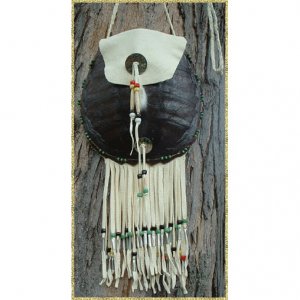
Native American Turtle Shell Purse By Vernon Long Soldier
A real, polished turtle shell creates the front of this purse / pouch.
This is not a sea turtle shell. We were told it was a sand or snapping turtle shell.
Created on a South Dakota reservation from naturally occurring species of the area.
Accented with Abalone, Ermine fur, beads, and leather fringe, it is truly stunning!
The back is leather and decorated with small beads.
The beads are of traditional Dakota~Lakota colors.
The front and back are sewn together with sinew.
The inside of the purse is not as large as a standard purse but
it will hold all of the necessities for a night out on the town.
It would actually make a beautiful wall hanging also.
This purse is about 17" long, including fringe, but not the shoulder strap.
The measurements of the shell are about 9" wide and 9 1/2" long.
The measurements of the Abalone shells are: Top - about 1 1/2", Bottom - 1 1/4'.
The long shoulder stap is of braided leather.
This beautiful item is shipped in a gift box.
About The Artist Of This Jewelry
Vernon Long Soldier
Oglala - Lakota
The Indian Arts and Crafts Act of 1990 ~ P.L. 101-644 ~
The Federal government started getting serious with those that misrepresent products to be Native American Indian made so they passed a law in 1990 to protect consumers. This law is "The Indian Arts an Crafts Act of 1990 ~ P.L. 101-644 ~" and concerns the truth-in-advertising law that prohibits misrepresentation of products sold as American Indian made within the United States, making it illegal to sell any art or craft product in a manner that falsely suggests it is produced by or is an Indian product, or the product of a particular Indian or Indian tribe or Indian arts and crafts organization. To learn more, visit the official site of the governing Indian Arts and Crafts Board and have the Indian Arts and Crafts Act of 1990 reprinted by clicking this link: http://www.doi.gov/iacb/act.html Violation of these laws carries very hefty fines with possible jail time.
Dakota Exchange guarantees that the Native American jewelry we sell is genuine. We enjoy promoting the beautiful Native American crafts and culture.
Authenticating Native American crafts should be easy when buying from a reputable dealer. Your first authenticity tip should be the price of the item. Due to the materials used, intricate details and time involved in creating a piece, the cost of authentic Native American jewelry is likely to be somewhat to very expensive.
Those selling authentic items will be able to tell you who the creating artist is. Many times, they will be able to tell you a bit about the artist and their background. The minimum background that you should find acceptable is the artist name and tribe they are enrolled with. ( Sometimes, a dealer will even supply the tribal number of the crafting artist. ) The basic background information will allow you the ability to contact the tribal headquarters to further authenticate the item you have purchased or are interested in purchasing.
You may be able to authenticate the item further through artist markings. Many artists use a trademark of sorts. You can attempt to identify the artist by their hallmarks, initials or signatures, generally found on the back of the piece. Investigate to see how the item compares to other crafts by the artist.
If a dealer does not tell you about the artist up front, ask questions! Do not assume that all items claimed to be Native American, are Native American. As in many other specialty items and collectibles, there are many counterfeits and copies out there. Use caution when a dealer can not give you minimal information about the artist and the tribe they are enrolled with. If you purchase an art or craft product represented to you as Indian-made, and you learn that it is not, first contact the dealer to request a refund. If the dealer does not respond to your request, you can also contact your local Better Business Bureau, Chamber of Commerce, and the local District Attorney's office, as you would with any consumer fraud complaint. Second, contact the Indian Arts and Crafts Board with your written complaint regarding violations of the Act.